A room in a home. What shapes the way we perceive it? The furnishings? The lighting? The experiences associated with that space? The list could go on, but perhaps it is fair to say that the easiest way to change the appearance of a room is to change its lighting: it looks one way in daylight and another under artificial light; one way when a small lamp stands at one end of the room, and another when it stands at the other. There is a certain parallel here with books: a book’s title is like the lighting in a room. Even if the content of the book remains the same, its title significantly shapes the way it is perceived.
This vivid comparison will help us introduce a new presentation of the spiritual conversations of the Venerable Servant of God Kunegunda Siwiec, entitled The Joyful Eyes of Love: Conversation. Does this introduction mean that the new book is almost identical in content to The Place of My Mercy and Rest, which some Polish readers may already know? That cannot be said, but it must be admitted that despite the different furnishings and lighting, it is still the same room.
A close friend of Kunegunda’s, Father Józef Czernecki, who died seventy-seven years ago, included in the last of his published books (Do Not Correct God, 1938, p. 22) a free adaptation of passages from Giovanni Papini’s “Prayer to Christ.” In Mary Prichard Agnetti’s English translation, the corresponding passages read :
All need Thee, even those who are unaware of their need — these most of all.
He who hungers goes in search of bread and knows not that his hunger is for Thee.
[…] he who is sick believes he is seeking health by many means, and his sickness is but due to his separation from Thee.
[…] and he who wearies himself in the vain search for peace seeks but Thee, who art the only peace wherein the most sorely troubled heart may find repose. All these invoke Thee without knowing that they do so, and their cry is infinitely more despairing than our own.
We do not cry out unto Thee for the pride of beholding Thee face to face as did the Galileans and the people of Judea […]. We do not ask for Thy grand descent in celestial glory, for the splendours of the Transfiguration, for the trumpet-call of the angels and all the sublime ceremonial of the final advent.
We desire Thee only, Thy person, Thy poor body that was pierced and bruised, that is clad in the coarse garments of the labourer; we would gaze into those Thine eyes that pierce the walls of bone and flesh which hide our hearts; that heal even when they wound by their wrath; that by their tenderness call forth tears of blood.
Does this fervent cry not seem to carry an echo of the longing that Saint Teresa of Jesus expressed in the following words from The Way of Perfection (26.3)?
I am not now asking you to meditate on Him, nor to produce great thoughts, nor to feel deep devotion: I only ask you to look at Him. Who can prevent your turning the eyes of your soul (but for an instant, if you can do no more) on our Lord? […] is it much to ask that you should sometimes lift your gaze from earth to fix it on Him? […] He longs so keenly for our glance that He will neglect no means to win it.
To meet Jesus’ ever-waiting gaze with our own. To let him fill our souls with love and joy:
As the Father loves me, so I also love you. Remain in my love. If you keep my commandments, you will remain in my love, just as I have kept my Father’s commandments and remain in his love. I have told you this so that my joy may be in you and your joy may be complete.
(John 15:9–11, NABRE)
How might the subtitle of the new presentation, Conversation, be read? One source of inspiration may be found in the continuation of Papini’s prayer, as adapted in Father Józef’s book. The corresponding passage reads:
And we would listen to Thy voice that fills even demons with dismay, so mighty is it, and charms little children, so sweet it is. […] Thou art aware, more profoundly aware than are we ourselves, that Thy presence is necessary and that Thy coming may not be deferred in this era that knows Thee not.
Kunegunda’s spiritual confidant, Father Bronisław Bartkowski, also pointed to the importance of listening attentively to the voice of Jesus. In his introduction to the words conveyed by Kunegunda, he wrote:
Perhaps it is simply a lack of attentiveness, excessive anxiety, and concern about many things (cf. Luke 10:38–41—Ed.) that keep us from hearing what the Lord says within us. Nor do we hear him when he speaks without the sound of words, as he spoke and as Saint Thérèse of the Child Jesus heard him within herself.
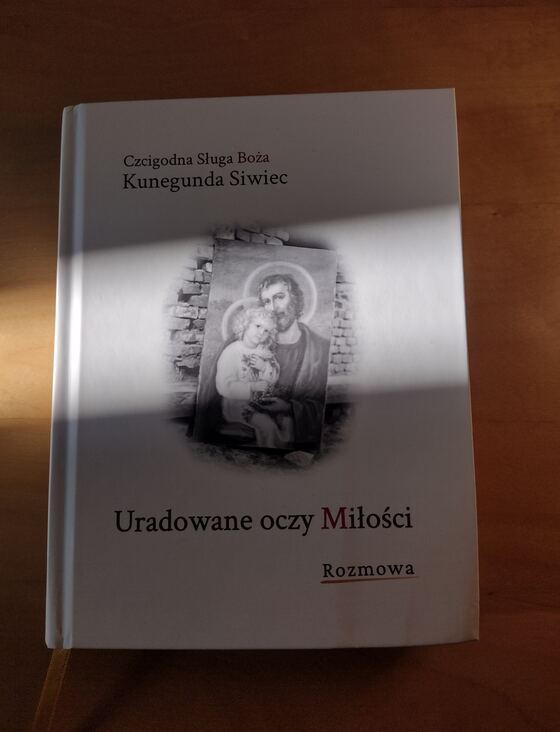
Analyzing the sources preserving the words conveyed by Kunegunda and preparing from them a text suitable for publication today inevitably entail many small linguistic and editorial decisions. The excerpts from the older English translation of “A Prayer to Christ” quoted above offer a concrete, though not entirely representative, illustration. If one wished today to convey their meaning to English-speaking readers, should archaic forms such as thee and thy be retained or replaced with modern equivalents? A more difficult question arises in the passage about Christ’s voice. The English translation says that it fills demons with dismay by its might and charms little children by its sweetness, whereas in the Italian text it terrifies demons by its sweetness and charms children by its might. Which version should be followed in presenting the passage to readers today? A responsible rendering would first require a comparison of the sources. Questions with comparable implications for the meaning of the text arose only occasionally. Even so, establishing anew the text of Kunegunda’s spiritual conversations from the sources required a meticulous examination of the linguistic and editorial issues encountered along the way. A detailed commentary on such matters is provided in the companion volume, The Spiritual Conversations of Kunegunda Siwiec: Analysis of the Sources and Establishment of the Text.
In Father Józef’s book, the adaptation of Papini’s “Prayer to Christ” ends as follows:
And we, in these grey and wicked days, in these years wherein horror and suffering are heaped in a measure that surpasses the powers of endurance, we who live to-day, must be saved, and saved without delay!
And all the love of which our ravaged hearts are capable is for Thee, O Crucified One, who wast tortured for our sakes and who now dost torture us with Thine implacable love.
The poignant cry above takes on still greater force when considered not only in relation to this passing life, but above all to eternity. Essentially, leading ourselves and others to eternal Joy by sharing God’s mercy, bearing the cross, and loving with childlike love is the heartbeat of Kunegunda Siwiec’s spiritual conversations—in both the earlier and the new presentations. Under the date of October 29, 1942 (note 6c in the new presentation), the following words were set down as having been heard from the Lord Jesus:
My eyes rest with delight on the souls who stand under the banner of the cross with love, courage, perseverance, and joy. Yet such souls are few. To the cross I give, many add their own, and that becomes their affliction.
Sources
Note: English translations of Polish-language titles are supplied for the reader’s convenience.
- Bartkowski, Bronisław, ed. [Maszynopis nowszy. Rozdziały wstępne] (Later Typescript: Introductory Chapters). Unpublished typescript. Stryszawa, ca. 1965.
- Czernecki, Józef. Nie poprawiać Pana Boga [Do Not Correct God]. Kraków: Drukarnia Powściągliwość i Praca, 1938.
- Garbol, Tomasz. “Ku upragnionemu Królestwu. O nowe tłumaczenie ‘Storia di Cristo’ Giovanniego Papiniego” [in Polish]. Ethos 38, no. 1 (149) (2025): 110–125. https://doi.org/10.12887/38-2025-1-149-09. Full text: repozytorium.kul.pl
- Papini, Giovanni. Storia di Cristo. 3rd rev. ed. Firenze: Vallecchi, 1922. https://archive.org/details/storiadicristo00papiuoft/
- Papini, Giovanni. The Story of Christ. Translated by Mary Prichard Agnetti. London: Hodder and Stoughton, [1923]. https://archive.org/details/storyofchrist00papiuoft/
- Siwiec, Kunegunda. Uradowane oczy Miłości. Rozmowa [The Joyful Eyes of Love: Conversation]. Prepared by Przemysław Zieliński. Kraków: OddM, 2026.
- Teresa of Jesus, Saint. The Way of Perfection. Translated from the autograph by the Benedictines of Stanbrook. Revised with notes and an introduction by Benedict Zimmerman, O.C.D. 2nd ed. London: Thomas Baker, 1919. https://archive.org/details/wayofperfection00tere
- United States Conference of Catholic Bishops. New American Bible, Revised Edition (NABRE) [online]. https://bible.usccb.org/bible